
All You Need to Know About Vaping
Your Complete Beginner’s Guide to Vaping by SilverSmoke
More and more people are switching from traditional cigarettes to e-cigarettes (electronic cigarettes) as a healthier and cleaner alternative. If you’re thinking about making the switch, this simple guide from SilverSmoke answers the most common questions for new users.
What is an e-cigarette
An e-cigarette is an electronic device designed to replicate the sensation of smoking. It heats a liquid (known as e-liquid) to create a vapour that can be inhaled.
There are many types of e-cigarettes — from budget-friendly starter kits to high-performance models for experienced vapers.
What are the benefits of e-cigarettes versus regular cigarettes
Traditional cigarette smoke contains over 4,000 harmful chemicals, including 43 carcinogens and 400+ toxins such as tar, carbon monoxide, ammonia, and arsenic.
E-cigarettes, on the other hand, are non-combustible — meaning they contain no ash, smoke, tar, or carcinogens. They also don’t produce the lingering odour associated with regular cigarettes and are generally considered less harmful to bystanders.
For more insight, check out our detailed article on common vaping myths.
What is an atomiser
The atomiser is a key component of a vaping device. It sits on top of the battery and uses heat to turn e-liquid into vapour.
Atomisers come in different styles:
- Disposable – convenient and easy to use
- Replaceable coil – cost-effective for regular users
- Rebuildable – ideal for experienced vapers who want complete control
What is a coil
A coil is the heart of your vaping device. It’s a small wire wrapped around cotton. When heated by the battery, it turns your e-liquid into vapour.
Coils are measured in ohms — a lower resistance means more heat, more vapour, and stronger flavour, but also faster battery and e-liquid use.
What is sub-ohm vaping
Sub-ohm vaping refers to using a coil with a resistance of less than 1 ohm. This allows for higher power, greater airflow, and the creation of large vapour clouds.
Modern sub-ohm devices and pre-built coils make it easy to enjoy this advanced style of vaping safely. However, too much power can overheat the coil — leading to a burnt taste — so moderation is key.
When should I replace my coil
You’ll know it’s time to replace your coil when:
- You notice a burnt taste
- The flavour weakens
- Vapour production drops
The lifespan depends on how often you vape, your power settings, and the type of e-liquid you use.
How do I prime my coil to avoid burning it out early
Properly priming your coil helps prevent dry hits and early burnout:
- Add a few drops of e-liquid to the cotton holes on the coil.
- Refit the coil and fill your tank.
- Let it sit for a few minutes.
- Take a few puffs without pressing the fire button (“primer puffs”).
- Start vaping on a low power setting, then gradually increase.
You’re now ready to vape smoothly!
What’s the difference between Mouth-to-Lung (MTL) and Direct-to-Lung (DTL) vaping
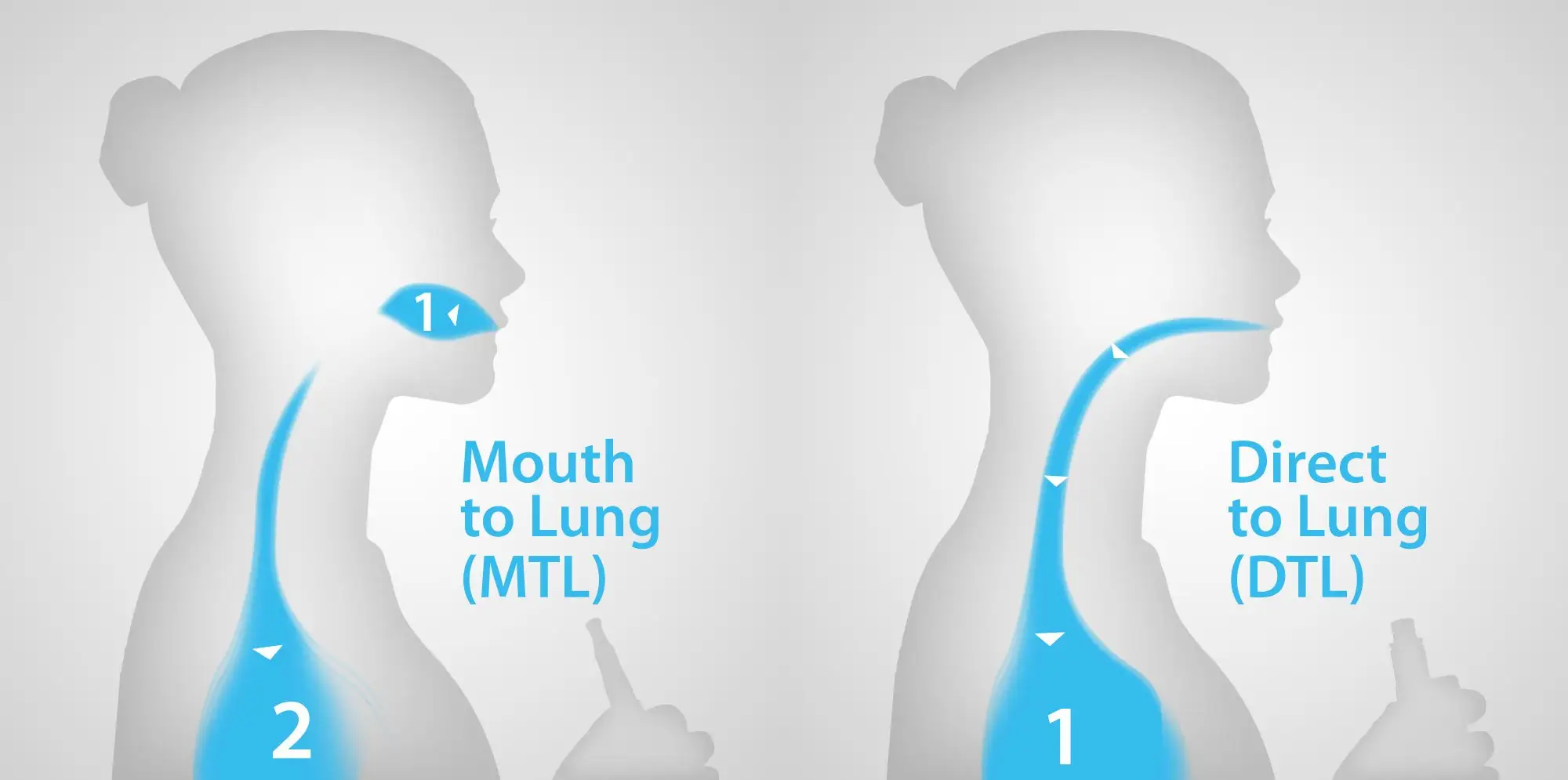
Mouth to Lung (MTL)
With MTL, you inhale vapour into your mouth first, then into your lungs — much like smoking a traditional cigarette.
It’s ideal for beginners since it delivers a familiar draw and allows for higher nicotine and PG ratios.
Direct to Lung (DTL)
DTL vaping involves inhaling vapour straight into your lungs. It produces larger clouds and richer flavour, but usually requires lower nicotine strength and higher VG e-liquids for a smoother experience.
What is e-liquid
E-liquid (also called vape juice or e-juice) is the substance vaporized by your device. It typically contains:
- Propylene Glycol (PG)
- Vegetable Glycerine (VG)
- Flavouring
- Nicotine (optional)
Your ideal e-liquid depends on personal preference.
- More PG = stronger throat hit
- More VG = thicker vapour and smoother flavour
Try a few different blends to find your favourite combination of taste, throat hit, and vapour density.
Which nicotine strength should I choose
Nicotine strength is measured in milligrams per millilitre (mg/ml).
Here’s a simple guide for new vapers switching from cigarettes:
Cigarette Habit | Suggested Nicotine Strength |
10+ regular cigarettes/day | 18mg |
Up to 10 light cigarettes/day | 12mg |
Up to 10 ultra-light cigarettes/day | 6mg |
Very light/occasional smoker | 3mg |
Non-smoker | 0mg |
Keep in mind that flavour type and PG/VG ratio can also influence how strong the nicotine feels.
What are Propylene Glycol (PG) and Vegetable Glycerine (VG)
Both PG and VG are safe, food-grade ingredients used in many foods and cosmetics.
- PG (Propylene Glycol):
A thin, tasteless liquid that enhances throat hit and carries flavour well. Ideal for low-powered devices and higher nicotine levels.
Note: Some users may experience mild throat dryness from high PG levels. - VG (Vegetable Glycerine):
A thicker, slightly sweet liquid that produces dense vapour and smooth flavour. Commonly used in “cloud chasing” setups and lower nicotine strengths.
Most beginners start with a 50/50 PG/VG mix, then adjust based on preference — for example, 70VG/30PG for bigger clouds or 60PG/40VG for stronger throat hit.
If you’re sensitive or allergic to PG or VG, choose a blend that reduces that ingredient.
What PG/VG ratio does SilverSmoke use
Our SilverSmoke UK-made e-liquids typically feature a 50/50 VG/PG blend — perfect for smooth flavour and balanced vapour.
For cloud enthusiasts, our premium high-VG range offers 70VG/30PG or 80VG/20PG blends, delivering superior vapour production and flavour intensity.
Battery and Coil Safety
Safety always comes first. Please read our Battery and Coil Safety Guide for essential tips on handling, charging, and maintaining your vaping equipment properly.